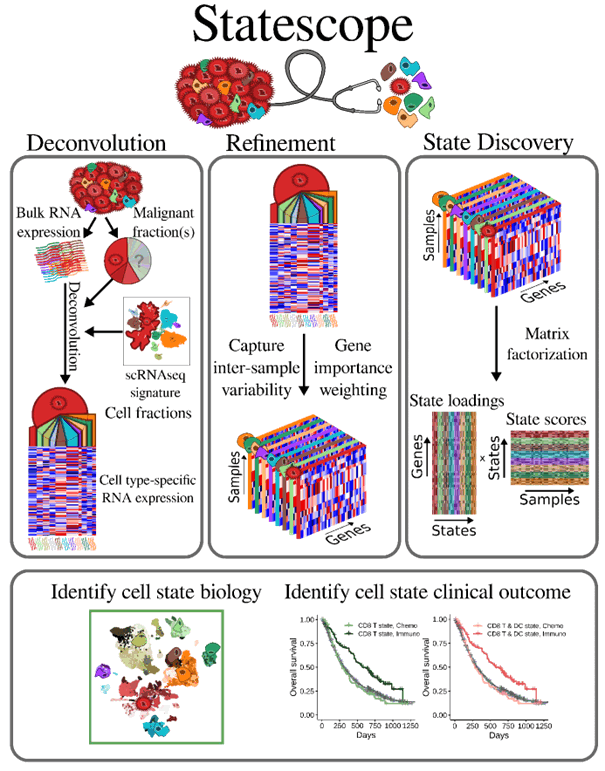
Statescope: an integrative deconvolution framework for discovering cell states in tumorsAccurate deconvolution of cell states from
bulk tumor RNA-seq is hindered by heterogeneous malignant cells specifically in cancer applications.
We present Statescope, a Bayesian framework that incorporates DNA-derived malignant cell purity to overcome this
heterogeneity and explicitly models inter-sample variation to accurately identify cell states. Comprehensive
benchmarking shows Statescope outperforms existing methods in both cell fraction and state estimation, and is
unique in its ability to identify states entirely absent from single-cell references. In real-data applications,
Statescope successfully recapitulates established cell states, including multiple states in neutrophils, a cell
type often missed by single-cell methods in lung cancer. Critically, in the POPLAR/OAK clinical trials,
Statescope identifies a combinatorial signature of effector CD8 positive T cells and conventional dendritic cell
states that together predict a striking survival benefit from immunotherapy. Collectively, Statescope transforms
deconvolution into a versatile discovery platform, enabling deeper biological and clinical insights from widely
available bulk multi-omics data.
The data presented here belong to the manuscript:
Janssen J, Steketee MFB, Bose A, van Asten S, Eijk PP, Dijk F, Farina Sarasqueta A, van Maldegem F, Noske DP, Bahce I, Koster J, Garcia Vallejo JJ, Schoonhoven R, van de Wiel MA, Radonic T, Ylstra B, Kim Y, (2026). Statescope: an integrative deconvolution framework for discovering cell states in tumors. Nat Commun 17: doi | |||||||||||